
GRUS takes the track apart and puts it back as grains.
Granular that stays in time and in key. The grains fall on the host grid, 1/4 down to 1/32 with triplets, and take their pitch from a chord instead of a random range. Since 0.2 the delay, the grain length, the scatter and the read head lock to that same grid — and a REPEAT section holds a slice and plays it again.
For producers who want to take apart what is already on the track. Not a synth — GRUS makes nothing on its own, it needs something to chew on.
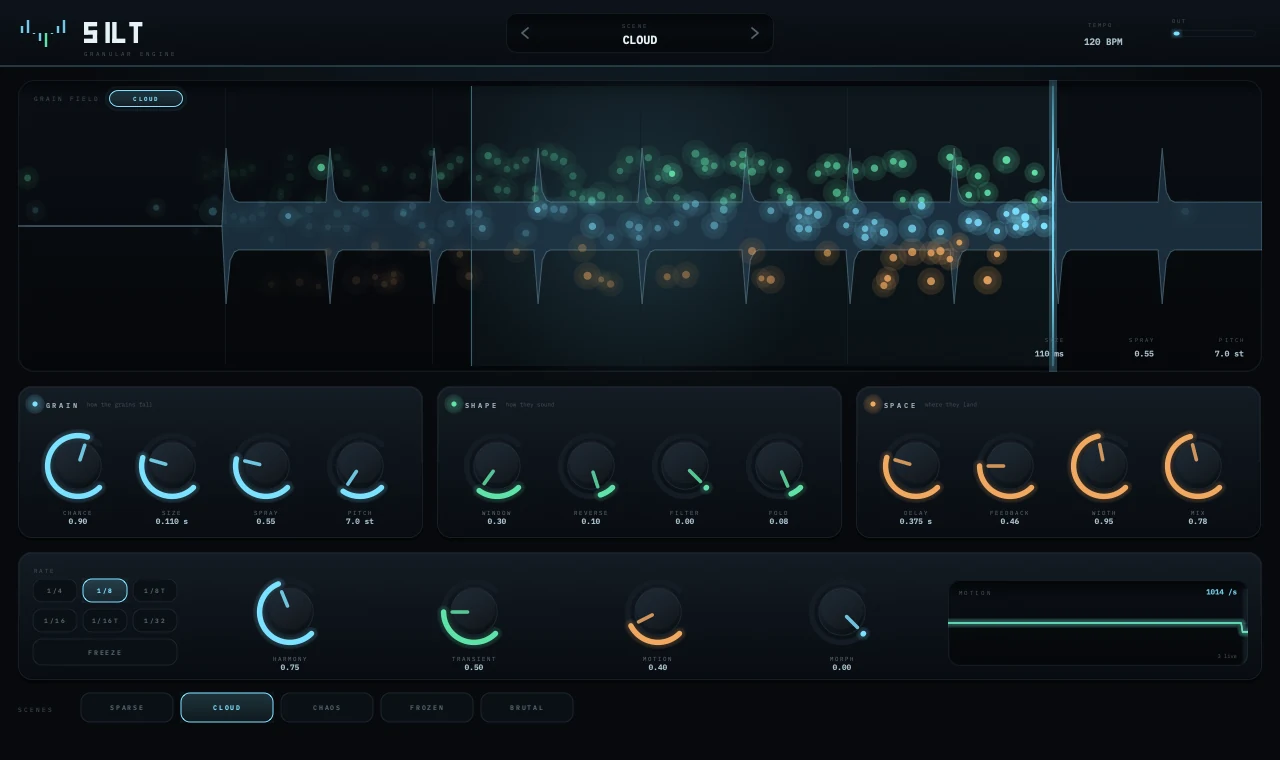
Grains that land on the beat
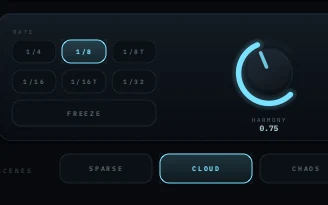
Free-running granular turns everything into a wash. GRUS fires grains on a grid locked to the host tempo — 1/4 down to 1/32 with triplets — always on the count and by probability in between. The single biggest change this engine went through.
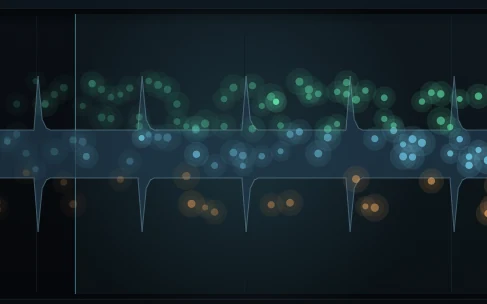
A grain takes a degree from a chord. Fifths, minor, sus or octaves, across two octaves — instead of a random pitch inside a range. One knob crossfades between the chord and the scatter, so the same texture runs from consonant to cloudy.
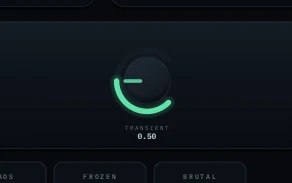
GRUS watches the input for attacks and fires a burst of grains that read exactly where the attack sits. That is why the source keeps its groove instead of dissolving. A fast and a slow envelope, 45 ms between hits.

SPARSE, CLOUD, CHAOS, FROZEN, BRUTAL. MORPH pushes density, grain length, spray, pitch range, reverse share, fold, filter, drive, feedback and the grid all at once — the knob you record an automation lane with.
Everything on the tempo, not just the trigger
Locking only the grain trigger gets you halfway. The echo still drifts, the grains are still whatever length the knob says, and the scatter still reads from wherever it lands — which is exactly why granular turns a beat into a wash. Every one of those can now sit on the host grid, each with its own switch, because a pad wants the scatter free and a drum loop does not.
| Grain trigger | 1/4 down to 1/32 with triplets, on the count and by probability in between. This was already there; it now sits with the rest. |
|---|---|
| Delay | 1/2 down to 1/32 including dotted values. On the grid both sides run the same length, so the crossed feedback answers on the other side — ping-pong in time. Off the grid the right side stays 1.347× longer, which is where the width came from. |
| Grain length | The grain is exactly one note value long instead of the knob's milliseconds. Free, the length scatters ±30 % so the cloud breathes; on the grid it does not scatter at all, because that would be the opposite of the point. |
| Scatter | SPRAY jumps in whole grid steps. A displaced grain reads exactly one count earlier rather than somewhere near it — the difference between a cloud and a beat that comes back offset. |
| Read head | TIME stops sliding and stands on whole steps: stretching becomes stuttering that lands on the count. |
| Pitch | Grain pitch snaps to whole semitones instead of landing 1.6 of one away. |
| Repeat | A slice is captured on a grid step and played again, two to eight times, 1/2 down to 1/32. It sits before the delay, so the echo falls on the repeats and not the other way round. A probability knob decides how often — at 0.25 it hits roughly every fourth step, which is a fill, not a gimmick. |
Six presets ship on the grid — Sixteenth Lock, Beat Repeat, Triplet Spill, Quarter Stutter, Gated Choir and Machine Fill. The other fifty are untouched, note for note.
Same loop, same level
All of it comes out of the same engine the plugin runs, driven by the same 120 BPM loop — kick, hats, chord stabs and bass. Nothing was sweetened afterwards: no reverb, no mastering, no edit. Switch between dry and processed while it plays.
Measured, not asserted
A serial, not a leash
The serial is a calculation over your email address, not a key on a server — so nothing has to be switched on for the device to run, and nothing can be switched off. The full rule, including why prices here never drop after launch, is on one page.
Pricing policyGRUS on its own is $19. All six are $49.
That is $17.99 less than the four paid devices bought separately — and under the same rules as this page: a serial calculated from your email address, no account, no server to ask.
DREAMS is $19 of the $66.99 and is not finished — today $47.99 of the bundle is downloadable. The arithmetic in full.
Nineteen dollars, once
No trial clock. At this price a demo costs you more time than the plugin costs money, so instead: four recordings from the shipping engine with the dry loop beside them, the interface at full resolution, the measurements in public — and if it turns out not to be for you, Paddle refunds you within fourteen days, no reason needed.
If you have never used anything of ours, start here. TARN is a complete reverb for Ableton, costs an email address, and holds nothing back — same build, same measurements, same licence rules as the device on the right.
Get TARN free- Max for Live · Ableton Live 10, 11, 12
- Thirty-six presets, plus room for your own
- No expiry, no nag screen, nothing held back
- One click to leave the list again
Download link and serial arrive in the same email, and stay available under My licenses for as long as this label exists.
Sales tax or VAT added at checkout for your country.
- macOS, Apple silicon + Intel, AU and VST3
- Bound to your email, valid on every computer you use
- Offline — no account, no licence server
- Every update included, for as long as there are updates
- Fourteen days money back, handled by Paddle
Five scenes, no other presets, and no manual yet. Windows is not built.