Most reverbs are clever maths pretending to be a room. Convolution reverb takes the other road: someone goes to a real space, records how it answers a single sound, and your track gets played through that answer. Convolution reverb from real spaces is the closest you can get to putting a vocal inside a cathedral without hiring the cathedral. Below I explain how it works in plain words, walk through five rooms I keep coming back to, and show how I use them in a mix without turning everything into soup.
What is an impulse response?
Clap once in a stone stairwell and listen. What you hear after the clap is the room: the first reflections off the nearest walls, then a thickening wash, then a tail that dies away at its own speed and with its own colour. That whole answer to one short sound is the room's impulse response, or IR.
Acousticians capture it carefully. The old way is a starter pistol or a bursting balloon. The modern way is a loudspeaker playing a slow sine sweep from low to high, recorded by microphones somewhere else in the space; software then turns the sweep back into a single clean click and everything the room did to it. In the Maes Howe recordings I mention below, for example, a speaker in the centre of the chamber played a 15-second logarithmic sweep while microphones listened from the wall opposite the entrance.
And convolution?
Convolution is the maths that applies that answer to any sound. Every sample of your snare is treated as its own tiny clap, each one gets the room's full reply, and all the replies are added up. The result: your snare, played in that room, with every reflection exactly where the real walls put it. No algorithm decides what a cathedral sounds like. The cathedral already decided.
The trade-off is honesty. An IR is a photograph, not a model. You get the room exactly as it was on the day, from where the microphones stood. You can shape it afterwards, but you cannot ask a photograph to become a bigger room.
Convolution reverb from real spaces: five rooms
The library I build on is OpenAIR, the Open Acoustic Impulse Response Library run by Audiolab at the University of York. Contributors choose a Creative Commons licence for their recordings; the ones I use are CC BY 4.0, which means you can use them as long as you credit the source. These five are the ones I keep coming back to.
Hamilton Mausoleum: the longest echo in the world (for a while)
The Hamilton Mausoleum in Lanarkshire, Scotland, was built between the 1840s and 1858 for the 10th Duke of Hamilton. Its stone vault has long been said to hold the record for the longest echo of any man-made structure: the figure usually quoted is about 15 seconds for a slammed door to fade away. That is why people search for "longest echo in the world" and land on a Scottish tomb.
To be precise about it: the crown has since moved. Guinness World Records now lists the longest echo as 75 seconds, measured by acoustic engineer Trevor Cox with Allan Kilpatrick inside a disused oil storage tank at Inchindown, also in Scotland. The mausoleum is still the famous one, and for music it is the more useful one. A Hamilton Mausoleum reverb is enormous, dark and slow, and it turns a single piano note into a sustained chord of stone.
York Minster: the cathedral sound
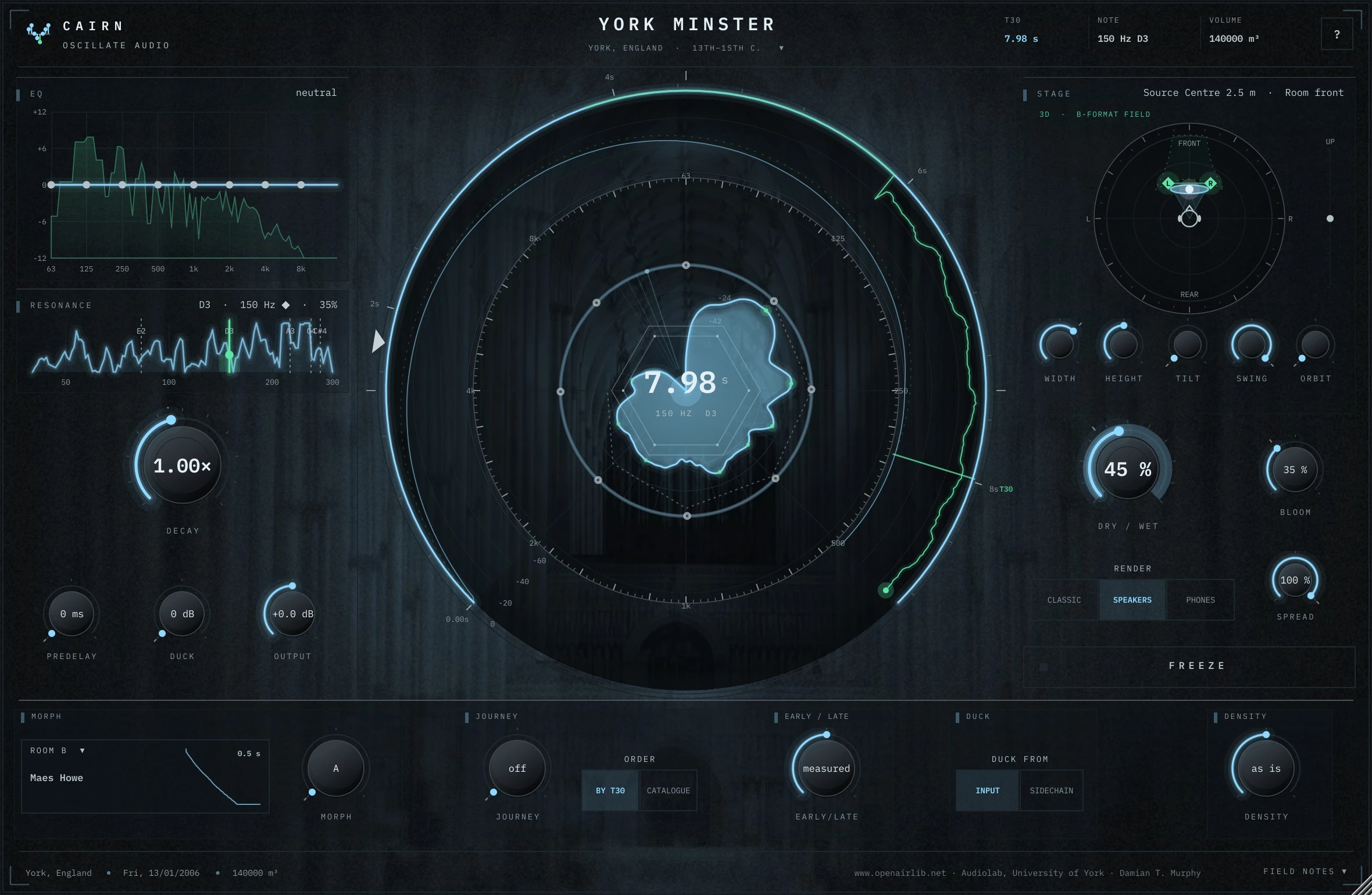
York Minster is the Gothic cathedral in York, begun in the 13th century and consecrated in 1472, roughly 160 metres long. If you have ever wanted the classic "choir in a cathedral" bloom, a York Minster impulse response is the reference: a long, smooth, slightly bright tail with a sense of height that plate and hall algorithms only approximate. It is gorgeous on sustained material and dangerous on anything busy.
Maes Howe: a 5,000-year-old stone chamber
Maes Howe (also spelled Maeshowe) is a Neolithic chambered cairn on Mainland Orkney, built around 2800 BC. A passage about 11 metres long leads into a nearly square chamber roughly 4.6 metres on each side; at the winter solstice the setting sun shines down that passage onto the back wall. Maes Howe acoustics are the opposite of the Minster: small, hard, close. The impulse response file is only about a second long, and the room sounds like dense stone right next to you. On drums it is wonderful: body and weight without any sense of distance.
R1 Reactor Hall, Stockholm
R1 was Sweden's first nuclear reactor, a research reactor at the KTH Royal Institute of Technology that went critical in 1954 and was shut down in 1970. The hall was blasted out of the rock about 25 metres below ground; the reactor itself was removed long ago, and the hall now serves as a venue for art, music and research. Concrete, rock and a lot of air: the result is a big, industrial, slightly metallic space that suits synths and techno better than any cathedral.
Innocent Railway Tunnel, Edinburgh
The Innocent Railway Tunnel was built in 1831 for the Edinburgh and Dalkeith Railway and runs about 517 metres under the city. Today it is a lit walking and cycling path. A long tube reflects sound very differently from a room: you get a flutter-like, rolling character, with reflections running along the tunnel instead of spreading out. On a vocal it sounds like a field recording; on percussion it sounds like a chase scene.
How to use real rooms in a mix
A real room gives you realism for free, which is exactly why it can swamp a mix. These are the habits that keep it working for me.
Put it on a send, not an insert
In Ableton Live, put the reverb on a Return track, set it to 100% wet, and feed it from the Send knobs on each channel. One room on a return glues several parts into the same space and costs one instance instead of eight. Use an insert only when one sound needs a room the others should not share, such as a deliberately distant vocal chop, and then work with the dry/wet control.
Use pre-delay to keep the source in front
Pre-delay is the gap between the dry sound and the start of the reverb. A long space like York Minster with no pre-delay smears a vocal's consonants straight into the tail. Twenty to forty milliseconds lets the words land first and the room follow, so the voice stays close while the space still sounds huge. For drums, try timing it to a fraction of the beat.
EQ the tail, not the dry signal
Real rooms often carry a lot of low end; a stone vault especially. High-pass the reverb return somewhere around 150 to 300 Hz and most mud disappears without the room losing its size. If the tail sounds harsh, roll off the top a little too. Always EQ the wet signal only. Your dry sound is already right.
Match the room length to the part
- Short rooms (Maes Howe, small chambers): drums, plucks, dry vocals that need body without distance.
- Long rooms (York Minster, Hamilton Mausoleum): pads, sustained vocals, single hits in a breakdown, transitions.
- Odd rooms (a tunnel, a reactor hall): character and sound design, often at lower send levels than you would think.
A useful trick: use a short real room on the whole drum bus at a low level for cohesion, and a long one only on the few elements that should float.
Try it with Live's own tools first
You do not need a third-party plugin to start. Live's Hybrid Reverb has a convolution engine with its own impulse responses, and you can drag your own IR file onto its waveform display to load it. It also has pre-delay and a four-band EQ. Download a room from OpenAIR, drop the WAV in, and you are mixing in a real space within five minutes.
Placing a room behind or above you is its own topic; I go into it in binaural reverb for headphones.
A free way in: TARN
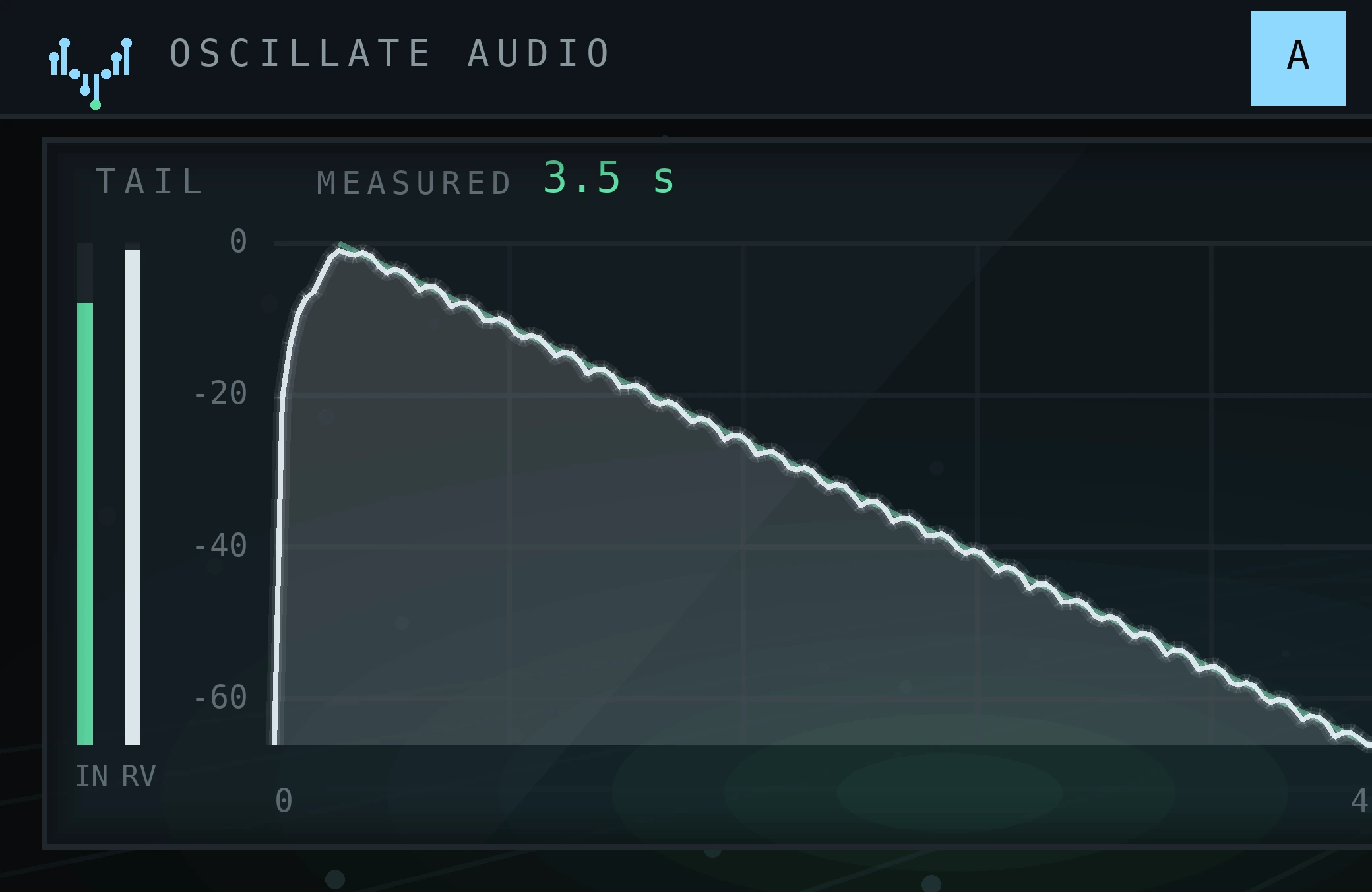
If you want to hear these spaces before spending anything, TARN is a free reverb for Max for Live (Ableton Live 10, 11 and 12). It ships with five rooms from CAIRN: York Minster, the Hamilton Mausoleum, the R1 reactor hall, Maes Howe and the Innocent Railway Tunnel.
To be clear about the difference: TARN does not load the recordings. There is no audio data inside; its room presets are numbers fitted to the same OpenAIR measurements CAIRN is made of. So it is not convolution, but the decay shapes come from the real rooms, and you get a freeze that holds, an eight-band EQ on the wet signal only, and decay from 0.2 to 60 seconds.
A word on credits and reconstructions
Every real-room reverb owes its sound to people who carried speakers and microphones into tombs and tunnels. CAIRN's impulse responses come from OpenAIR (Audiolab, University of York) under CC BY 4.0, and the photos inside the plugin come from Wikimedia Commons with credits in each room's field note. Two of the rooms in CAIRN are reconstructions rather than direct recordings, and the plugin says so. I think that matters: if you are going to tell a listener a sound comes from a 5,000-year-old chamber, it should.
Questions people ask
What is an impulse response?
An impulse response is a recording of how a space answers one short sound, like a clap or a sine sweep turned into a click. It contains every reflection and the full decay, so a convolution reverb can apply that room to any audio.
What is the difference between convolution and algorithmic reverb?
Convolution reverb plays your audio through a recorded impulse response of a real space. Algorithmic reverb builds the reflections from delays and filters, which is easier to reshape but is an approximation of a room.
Where is the longest echo in the world?
Guinness World Records lists 75 seconds, measured by Trevor Cox inside a disused oil storage tank at Inchindown, Scotland. Before that, the Hamilton Mausoleum in Lanarkshire was famous for the longest echo of a man-made structure, usually quoted at about 15 seconds.
Can I use impulse responses in Ableton Live without a plugin?
Yes. Live's Hybrid Reverb has a convolution engine, and you can drag your own impulse response file onto its waveform display to load it.
Are OpenAIR impulse responses free to use in music?
OpenAIR contributors choose a Creative Commons licence for each recording. Many, including the ones CAIRN uses, are CC BY 4.0, which allows use as long as you credit the source; check the licence of each IR you download.